The highest highs and lowests lows....
The Northern Coast

The Northern Coast--photo by Zack Thieman
Wednesday, August 24, 2011


The Amanda Show
I dearly wish I could have a camera strapped to my head at all times. You know, the ones people who play extreme sports wear as they’re climbing daring heights, soaring over landscapes with synthetic wings, or maneuvering their way around jagged rocks and through Class V rapids. Maybe then I could better let everyone back home see the beauty and poverty of the areas around me mixed in such a striking yet modest way. Then everyone could experience almost first hand the confusion I feel whenever I’m at a ceremony and music is loudly playing in the background, everyone talking over eachother with a language not yet perfectly known, and then suddenly everyone is looking at me and I am beckoned to the front to do Lord knows what because I just can’t hear or understand them over all the noise. I just know they are waving at me in a way that if I were in the States would signify, “Shoo! Go away!” but here means, “Get over here!” I am in a constant state of ultra awareness, straining my ears for key words that would signal for me to talk, searching the faces of those around me, or simply watching their movements so that I might mimic them. I try to always smile. I try to sound like I know more Spanish than I do. I don’t think that part is working though, so I just keep nodding my head and smiling. You just gotta keep smiling, because if you can’t fully express yourself at least they won’t think you’re mean, or worse yet, bored.
But even with the camera strapped to my head allowing you to see the stares as I walk down the street, or the children crowding outside the windows of every classroom I stand in for a chance to see the gringa, you may only barely be able to hear the giggles and collective gasps from the girls. You will most definitely hear the whistles and occasional “Hello, baby,” from the boys.
You would be able to see the sun shining so bright and clearly just like a summer day (even in the winter), yet everyone still wearing jackets and pants and complaining about the chill. You wouldn’t however, be able to feel the extreme difference between standing in the shade or the sun; the shade giving you goose bumps, and the sun practically peeling your skin off in that instant, completely skipping the process of getting a sunburn.
I’m pretty sure you would be able to see how much my town is like an oasis in the desert—vast and desolate miles of sand and volcanic mountains surround us, yet there are palm trees and fruits grown here that are associated with the tropics (mango, papaya, avocado, sugar cane, and fruits I have never seen before in my entire life.) You wouldn’t however feel the intense itching and swelling of my legs from the tiny bugs I’ve never seen but have caused intense discomfort and warped my legs with swollen bumps. You wouldn’t be able to experience my morning ritual of putting on sunscreen and bug spray that is usually reserved for camping trips.
You most definitely wouldn’t feel how tired I am by two ‘o’ clock just from the energy I’ve exerted in not looking completely lost and confused. You’d hear me fumbling with my words, my tongue tripping over itself as I try to speak when I can’t even think straight let alone form a complete sentence in Spanish.
There are so many things you would see and finally understand, and still so much you would still miss. But even if you couldn’t understand a damn thing anyone was saying, even if you paid more attention to the construction of the buildings, the trash on the ground, or the lack of paved roads, you would still see the look on the faces of those around me and hear the tone in their voice. You would see the smiles, the hands reaching out in greeting and kisses on the cheek. You would realize no matter how foreign it seems now it will eventually become easier. They are receiving me with open arms, and even if right now they giggle at my language slip ups and I am the most bizarre person they have ever met, that is more than I can ask for.
Sunday, August 14, 2011
Site assignment; the unveiling of a mystery
This blog is already getting away from me.
Week ten?! Do you know what this means? This means my training is over. All that is left is final interviews and projects, many despedidas to the friends I’ve made in my training group, facilitators, language teachers, and host families, and the swearing in ceremony, the moment I finally become a volunteer.
Summer camp is over. The real stuff starts next week.
So, seeing as how I am this far along in the process, that means I’ve been very bad in keeping updated on what has brought us to this point. Site assignments, for one, and site visits to my new host family in my new town that I will be living in for the next two years. Let's start slow though, first with getting my site assignment.
Site assignment day was like a prolonged ulcer. They waited until a Wednesday to tell us our sites, and they waited until after lunch. Needless to say, many people had a hard time eating, but we had a big feast at our training center with both the business and youth volunteers, along with everyone from the Lima office. And, my host mom and host aunt prepared all the food!
 |
| My host mom and host aunt cookin' up a feast. |
 |
| Anticucho, papas, y ensalada cebolla. |
 |
| Zack, Sue, and Brittany try to weasel information out of Luis |
When it came time to learn our site assignments, they of course couldn’t just let us know without ceremony. Our first assignment: find our language instructor. After searching the training center grounds high and low, I spotted her hiding under a tree behind some brush. She then gave each of us in our language class a cardboard piece of pizza, and we were instructed to find other people with the same kind of pizza. As you can imagine, the training center was filled with shouts, people running around and calling out, “Pepperoni! Pepperoni!” or “Cheese? Cheese?” My pizza was an “everything” pizza, and soon I found four others with the same kind, one my friend Zach from my language class (and my neighbor here in Buenos Aires) and the other three business volunteers. We looked at eachother, still not sure where we were going but wondering, “So, is this us? Is this our group going to the same region?” Because not only are we going to the same region, we are going to the same regional meetings once a month, we’ll have the same regional capital, and we’ll essentially be seeing more of each other than we will anyone else in our entire group for the next two-years. So while we were hurried to figure out the next step (a cryptic message on the back of the pizza pieces that needed decoding) we also took a moment to look at eachother and take in the faces of our people for the next two years. After decoding the message, learning we had to find a certain staff member for the next clue, and then tackling him to the ground (after a good chase, of course) we got the next cryptic message, this time a little easier to de-code. It didn’t take long for me to descramble the word puzzle, the letters only helped spell one region in Peru:
Lambayeque.
 | ||
| My Regional Coordinator with a map of Lambayeque. |
So, that was it. We were going to Lambayeque. Tents were set out all over the training center grounds, and each region had a station already set up with a Regional Coordinator at each place holding a map with our names on it. (There are twenty-four regions in Peru, but Peace Corps only sends volunteers to nine.) Our coordinator handed us a folder with our names on it and inside it had everything-- the name of our town*, the population, the names of our host family—everything.
I have spent so much of my time in the Peace Corps in the dark, blanketed with ambiguity. First I had no idea where in the world I would be sent, when, or what I would be doing, or if I would even be accepted. Then I had no idea what country I would be sent to. Then if that wasn’t enough, when I got to the country I had no idea what town or region I would be sent to. And then suddenly, in one folder, were the answers. I was in complete shock.
I had just gone from weeks of anxiety and pondering, five-minutes of running around in circles searching for cheesy puzzle pieces (pun intended), to sitting in a chair with it all laid out in front of me. Facilitators came up and patted me on the back, gave me congratulations, and asked how I felt. To be honest, I felt like crying.
It was an overwhelming moment, the denouement of our training as Peru 17. Not only that, but this moment was over a year in the making since I first applied for the Peace Corps in July of 2010. There were times when I felt it would never come. And in truth, Lambayeque was probably the region I knew the least about of all the regions Peace Corps sends volunteers to. I looked around and many of my friends sat in their individual sections for the regions they would soon be heading to, which are on the opposite end of Peru. I may not see many of these people for another year until our mid-service training.
I looked through my folder over and over again, trying to absorb what I realized were superficial details about the place I would soon call “home”. I would be living in a town of 4,000, forty-minutes from the regional capital, forty-minutes from my friend Zack, thirty-minutes from the beach. I knew my host family’s names and ages, but were the nice? I knew my town had electricity and running water, but was it accessible to everybody? Here lay all the answers, but at the same time, the answers were still trivial. The blanket of ambiguity was only slightly lifted.
 |
| The Cajamarca group talking to their RC |
I looked over at my compañeros each holding their own folder and noticed they had more information in theirs than mine. They had pictures, pages of writing, maps; I only had two sheets of paper with names, phone numbers, general town information.
“Why don’t I have that?” I asked.
“Because you will be the first volunteer to ever live at that site,” my friend Zack said.
Everyone else had detailed writing and maps because other volunteers had lived there and wrote them. I was entering new Peace Corps territory. I would be laying down the foundation for future volunteers. This means two things: 1) I won’t have to spend my time being compared to volunteers of the past (ie, “Kristin always made us cookies,” or “Jake had a science program that everyone loved.”); 2) I will have to lay the groundwork for what the Peace Corps actually is. Many first volunteers spend the majority of their time just getting people to understand who they are and why they are there. All sites have to request a volunteer in order to get one, but that doesn’t mean the entire town knows or understands why some gringo is living there and keeps wanting to do projects and hang out.
I had originally requested a site where I would be replacing a former volunteer, so I was surprised to find out my “newcomer” status. But after reflecting on it and talking with trainers I realized it was better this way. I came into the Peace Corps wanting a challenge, and while day-to-day life here is a challenge, I shouldn’t shy away from having a little extra work. I will just have to be extra-outgoing, extra-inquisitive, and be prepared for some extra-awkward situations. And while I may not do things perfectly, I’ll work with what I have and the next volunteer will have more opportunities to build even better programs and work with even more people. And maybe they’ll even spend some of their time being compared to me.
 |
| Peru 17 |
*Due to Peace Corps safety and security regulations on blogs, I’m not allowed to say my exact location in Peru. However, I can’t promise I won’t slip up and say it on here sometime in the next two years.
Tuesday, July 26, 2011
The Million Soles Question
Being a gringo in Peru leaves you vulnerable to a lot of questions and prodding. Peruvians don’t find it prying to ask things like, “Are you married? Are you dating someone? Do they live here? Are you going to leave them for a Peruvian?” or “Where are you from? What are you doing here? Where do you live?” One grows accustomed to divulging parts of their life to complete strangers, or at least making up something to tell them. We actually have sessions on this sort of thing.
However, there is one question I am still not good at answering. The dreaded question I have been asked time and time again and have yet to come up with a precise or articulate answer for:
“Why did you join the Peace Corps?”
Oh, how I loathe this question!
I already addressed this slightly in my entry “The Interview” before I joined, but then it was, “Why do you want to join the Peace Corps?” Either way, the sentiment is still the same. Even as I sit in my small humble room adorned with only two decorations (a picture of Jesus, Mary, and Joseph, and a poster of Marvin the Martian) 1000’s of miles from home in a foreign land that grows on me day by day, I cannot answer this question.
Part of the reason I can’t is because the answer changes all the time. In my first essay I sent with my Peace Corps application I wrote, “I have wanted to live my life the way anyone with an open heart, adventurous spirit, and hungry mind would. Helping others and integrating myself into a new country and culture fits my life story.” Before it was about adventure, challenges, and a broader global understanding. It still is all these things, but there’s something else added; like the smiles and laughter coming from the children I’m talking to in my charlas, my host brother shouting my name and opening his arms for a hug from his hermana gringa, or my host family telling me I speak, “como una peruana.”
The point is there is no concrete black and white answer. It’s a feeling-- a growing, living thing. The most precise answer I can give is, “it spoke to me.”
The other day I was talking with some fellow aspirantes and we discovered many of us had “a song” before we left the States that really spoke to us about where we were in our lives as we readied ourselves to embark on this journey. Helplessness Blues by Fleet Foxes had just come out, and its timing and relevance struck me. There was awhile when I couldn’t even listen to this song before I left because it made me cry cada vez. This song still chokes me up even if I’m listening to it crammed in a combe. If you listen to the words, I’m sure you’ll find a message that helps explain why I am where I am. Maybe the music will help convey the feelings I cannot express.
I was raised up believing
I was somehow unique
Like a snowflake distinct among snowflakes
Unique in each way you can see
And now after some thinking
I'd say I'd rather be
A functioning cog in some great machinery
Serving something beyond me
But I don't, I don't know what that will be
I'll get back to you someday soon you will see
What's my name, what's my station
Oh just tell me what I should do
I don't need to be kind to the armies of night
That would do such injustice to you
Or bow down and be grateful
And say "Sure take all that you see"
To the men who move only in dimly-lit halls
And determine my future for me
And I don't, I don't know who to believe
I'll get back to you someday soon you will see
If I know only one thing
It's that every thing that I see
Of the world outside is so inconceivable
Often I barely can speak
Yeah I'm tongue tied and dizzy
And I can't keep it to myself
What good is it to sing helplessness blues?
Why should I wait for anyone else?
And I know, I know you will keep me on the shelf
I'll come back to you someday soon myself
If I had an orchard
I'd work till I'm raw
If I had an orchard
I'd work till I'm sore
And you would wait tables
And soon run the store
Gold hair in the sunlight
My light in the dawn
If I had an orchard
I'd work till I'm sore
If I had an orchard
I'd work till I'm sore
Someday I'll be
Like the man on the screen
I was somehow unique
Like a snowflake distinct among snowflakes
Unique in each way you can see
And now after some thinking
I'd say I'd rather be
A functioning cog in some great machinery
Serving something beyond me
But I don't, I don't know what that will be
I'll get back to you someday soon you will see
What's my name, what's my station
Oh just tell me what I should do
I don't need to be kind to the armies of night
That would do such injustice to you
Or bow down and be grateful
And say "Sure take all that you see"
To the men who move only in dimly-lit halls
And determine my future for me
And I don't, I don't know who to believe
I'll get back to you someday soon you will see
If I know only one thing
It's that every thing that I see
Of the world outside is so inconceivable
Often I barely can speak
Yeah I'm tongue tied and dizzy
And I can't keep it to myself
What good is it to sing helplessness blues?
Why should I wait for anyone else?
And I know, I know you will keep me on the shelf
I'll come back to you someday soon myself
If I had an orchard
I'd work till I'm raw
If I had an orchard
I'd work till I'm sore
And you would wait tables
And soon run the store
Gold hair in the sunlight
My light in the dawn
If I had an orchard
I'd work till I'm sore
If I had an orchard
I'd work till I'm sore
Someday I'll be
Like the man on the screen
Sunday, July 24, 2011
Field Based Training- La Libertad
Many Peace Corps Volunteers say the first time they truly started feeling like a volunteer was during field based training (FBT). I just got back from a crazy week in La Libertad doing everything from brushing kids teeth to giving charlas to Peruvian youth on recycling, hygiene, English, and communication techniques with their parents. We spent time in slow, sleepy beach towns, as well as sites that reached above 8,000 feet in elevetation in the sierra. The scenery was phenomenal, the experiences were rewarding, and our (little) spare time was never ill spent.
Day One:
I suppose day one actually started the night before, since we took a night bus from Lima to Trujillo. We rolled into town around 7 am and soon thereafter hit the streets to do a scavenger hunt (which seems to be the number one favorite activity amongst trainers). We mostly spent the day getting to know our FBT leaders Ian and Kelsi, as well as some other volunteers who came to see "the newbies" (a term I'm getting really tired of). We spent some time in Huanchaco, a beach town close-by, where we mostly ate. Cebiche, seafood, ice cream, and pancakes were the foods of choice.
Day Two:
Our group made its way to the beach town of Puerto Malabrigo which is another youth development volunteer's site. She gave us a tour as well as took us to some schools she worked in. We got to help in brushing five-year-olds' teeth as well as apply fluoride, which one child promptly threw up.
This was then followed by a visit to a special education school where we met the students, learned about the school, and mostly emphasized the importance of brushing teeth than actually cleaning them ourselves. Our day ended with a beach cleanup (I've never done such intense trash pick-up in a five-foot radius before) and some trainees put on wet-suits and helped some niños get out in the waves to surf.
Day Three:
This day was a little harder than the others, mostly because I helped teach two-classes in a school in Bello Horizonte, our FBT leader Ian's site, and they didn't go so great. The younger elementary students were more than happy to learn the ABC's in English, but the older high school students didn't want have anything to do with our activity on communication techniques with their parents. I haven't felt more like throwing up in public due to embarrassment in a long time.
After we went to a home for children taken away from their family by the government due to abuse. They were great kids and they were excited to play games with a big group of gringos. Also, I was gifted a ton of food by a volunteer living there for the summer. She felt bad for me being gluten-free and struggling with healthy, GF food, and she is heading home soon. It was incredibly thoughtful of her! I may or may not have already eaten all of said food, except for a jar of almond butter.
Day Four:
This day we spent in a sierra site where a water and sanitation volunteer lives. The town sat above 8,000 feet in elevation and the mountains reminded me so much of home! My time in the classroom went much better this day, as I prepared a charla (this time by myself) on the importance of handwashing, and showed them how to make a "tippy tap", which is basically a handwashing system made out of an old water bottle. I presented it to a group of ten to eleven-year-olds', and they were incredibly receptive and participatory. I also helped give a quick charla on recycling with another trainee, which went just as well. I was lucky with my classes, though, as some people had students literally jumping on the desks like monkies.
Because my achilles tendon is still a wreck I couldn't join the crew on a hike, but I got a nap, which came in handy when I had to stay up until 1:00 am getting the next day's session plans prepared.
Day Five:
Another day of charlas, and they already felt easier. This day we were in Poroto, a beautiful site between the coast and the sierra where our FBT leader Kelsi lives. I helped give a charla on the importance of goal setting and future career possibilities with high school students. Speaking in Spanish in front of a group of youth is getting easier, too, even though I'm still messing up often on my grammar. After giving our own charlas, we spent more time at the school, and I somehow ended up singing the US National Anthem to a group of teenagers.
After school we went to the health post and met with some middle school to high school aged students in a "health promoter" group. We helped them organize and construct their own charlas for elementary school students.
Best stress-relieving part of the day: making enormous banana-oatmeal pancakes for everyone, having a five-person dance party, and telling ghost stories.
Day Six:
We show up to the school to help give the charlas with health promoters, and the school is having a "sports day". The director kind of forgot we needed children in classrooms to teach. However, it worked out and our twelve-year-old health promoter did an awesome job of teaching a class of 2nd graders about personal hygiene. We were mostly there for moral support and to make sure the class raised their hands before speaking. The rest of the day was busy with activities preparing us for our time as volunteers outside of the classroom.
Not-so-random-but-still-random-occurrence from the day: someone from our group pooped their pants.
Day Seven:
Our last morning was spent back in Bello Horizante helping paint trash cans to be placed around the community (public trash cans are almost non-existent in a lot of communities) and a mural that encouraged taking care of the environment.
After we got back to the hotel in Trujillo and cleaned up, we kidnapped our FBT leaders and took them to Starbucks where we presented them with hand-made certificates (certificates are a big thing in Peru; people love them) and treated them to their beverage of choice. This may not seem like much, but in the life of a volunteer, this is a treat!
The whole week was such a great experience. There were times that were challenging, especially staying up until the wee hours of the night creating original ideas for hour-long presentations in Spanish, and then waking up early to get ready and deliver them to an unfamiliar group of kids. Some of us had better luck than others on the reception we got from the kids, but all of us gained a wealth of experience.
I am starting to get really excited to find out my site, which will be August 3rd (two weeks away!). However, I am sad to think I will be leaving all of my great friends I've made behind. But, I know I will still see them when I can, and I will be forging relationships in site. FBT was overwhelming at times, but I feel more prepared for being a real volunteer than ever before. I'm excited to see where I'll be placed, and where you all will have a chance to come visit me!
Day One:
 |
| Enjoying some coffee that for once isn't instant |
Day Two:
 |
| Photo by Ian Arzeni-- getting ready to put fluoride on a girl's teeth. |
This was then followed by a visit to a special education school where we met the students, learned about the school, and mostly emphasized the importance of brushing teeth than actually cleaning them ourselves. Our day ended with a beach cleanup (I've never done such intense trash pick-up in a five-foot radius before) and some trainees put on wet-suits and helped some niños get out in the waves to surf.
Day Three:
This day was a little harder than the others, mostly because I helped teach two-classes in a school in Bello Horizonte, our FBT leader Ian's site, and they didn't go so great. The younger elementary students were more than happy to learn the ABC's in English, but the older high school students didn't want have anything to do with our activity on communication techniques with their parents. I haven't felt more like throwing up in public due to embarrassment in a long time.
After we went to a home for children taken away from their family by the government due to abuse. They were great kids and they were excited to play games with a big group of gringos. Also, I was gifted a ton of food by a volunteer living there for the summer. She felt bad for me being gluten-free and struggling with healthy, GF food, and she is heading home soon. It was incredibly thoughtful of her! I may or may not have already eaten all of said food, except for a jar of almond butter.
Day Four:
 | |
| Photo by Lindsay Buck-- in class teaching about handwashing. |
Because my achilles tendon is still a wreck I couldn't join the crew on a hike, but I got a nap, which came in handy when I had to stay up until 1:00 am getting the next day's session plans prepared.
Day Five:
 |
| In Poroto--Kerry and Kidist are amazing with kids |
After school we went to the health post and met with some middle school to high school aged students in a "health promoter" group. We helped them organize and construct their own charlas for elementary school students.
 |
| Eduar, our 12-year-old student health promoter helping me make papelotes for our hygiene charla |
 | ||
| Finished product |
Best stress-relieving part of the day: making enormous banana-oatmeal pancakes for everyone, having a five-person dance party, and telling ghost stories.
 |
| Photo by Lindsay Buck-- Making pancakes and eggs! |
 |
| Photo by the self-timed camera of Lindsay Buck |
We show up to the school to help give the charlas with health promoters, and the school is having a "sports day". The director kind of forgot we needed children in classrooms to teach. However, it worked out and our twelve-year-old health promoter did an awesome job of teaching a class of 2nd graders about personal hygiene. We were mostly there for moral support and to make sure the class raised their hands before speaking. The rest of the day was busy with activities preparing us for our time as volunteers outside of the classroom.
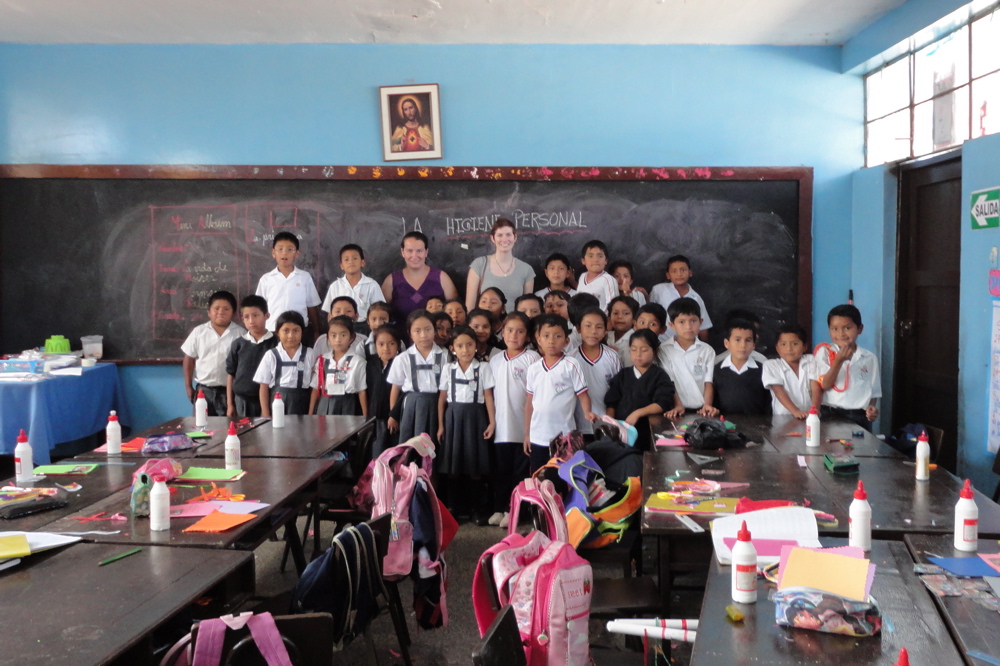 |
| Second-grade class in Poroto taught by a 12-year-old student health promoter |
Not-so-random-but-still-random-occurrence from the day: someone from our group pooped their pants.
Day Seven:
 |
| Photo by Lindsay Buck-- Medio Ambiante mural in Bello Horizante |
After we got back to the hotel in Trujillo and cleaned up, we kidnapped our FBT leaders and took them to Starbucks where we presented them with hand-made certificates (certificates are a big thing in Peru; people love them) and treated them to their beverage of choice. This may not seem like much, but in the life of a volunteer, this is a treat!
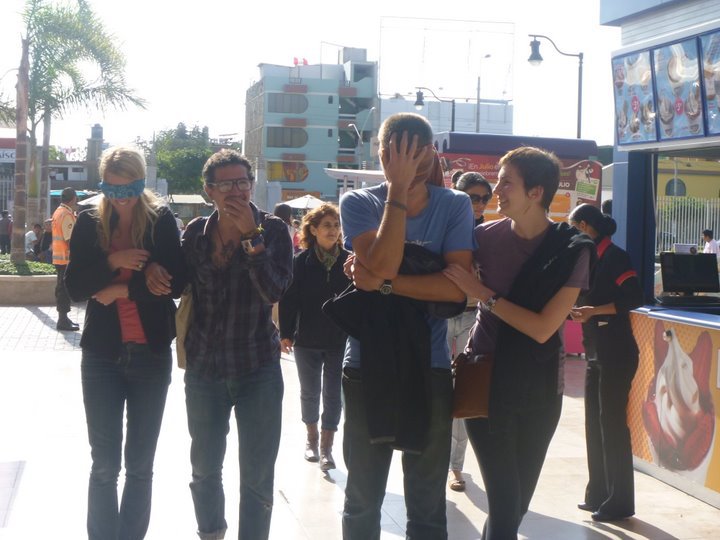 |
| Photo by Lindsay Buck-- Richard and I leading Kelsi and Ian to Starbucks. |
The whole week was such a great experience. There were times that were challenging, especially staying up until the wee hours of the night creating original ideas for hour-long presentations in Spanish, and then waking up early to get ready and deliver them to an unfamiliar group of kids. Some of us had better luck than others on the reception we got from the kids, but all of us gained a wealth of experience.
I am starting to get really excited to find out my site, which will be August 3rd (two weeks away!). However, I am sad to think I will be leaving all of my great friends I've made behind. But, I know I will still see them when I can, and I will be forging relationships in site. FBT was overwhelming at times, but I feel more prepared for being a real volunteer than ever before. I'm excited to see where I'll be placed, and where you all will have a chance to come visit me!
Friday, July 8, 2011
One down, twenty-six to go
 |
| Alpacas!! |
One month already??
Two-weeks ago it felt like months, and now it’s been four weeks and it feels impossible that we’ve already been here that long. Huh? How does time warp forward and then leap backwards again?
The days go by much quicker now that walking narrow streets strewn with trash, glass, and stray dogs has become a norm, and everyday tasks like throwing my toilet paper in the trash or boiling water to drink have become easier. Training is only 10 weeks, which means I am almost halfway through! In another month I’ll learn my site assignment and will go visit the place in which I’ll be living for the next two years, and even meet my new host family.
And my trainers honestly think I’ll be ready for that? Hard to believe. Then again, I’m in the Peace Corps and I’ve been living in Peru for a month; I have a hard time believing that sometimes.
The last four weeks have been intense, but I can definitely see the changes and progress everyone has made. For instance, today we had Spanish interviews to determine if we are going to move up a level or two in our language courses. Almost everyone has made so much progress I doubt many won’t be moved up another level, and that is incredible leaps and bounds in four weeks.
We are learning so much and doing so many activities, sometimes it’s a little much. In fact, most days training is too much; four hours of language training followed by four hours of guest speakers with information on everything from Peruvian customs to STD’s and back to the Peruvian education system. It’s a lot to take in on a daily basis. And then after all of that, it’s back to the host family to make small talk and eat another plate full of rice, followed by an hour of homework. Not to say we haven’t gotten our breaks. We’ve had barbecues, celebrated Peruvian holidays, celebrated American holidays (4th of July), and gone to Lima where we all divulged in many American treats (Starbucks, fast food, Pinkberry, etc). We work hard, we play hard, and somehow we’re all still standing or at least have the ability to help hold each other up.
 |
| Some of my buddies at the 4th of July celebration |
 |
| My Spanish class making papas rellenos in my host family's kitchen |
I think the intensity of training and the sheer amount of talent and experience our group holds creates a lot of conflicting feelings amongst everyone. A) We’re already good friends and have a hard time imagining service without our buddies there to lean on and share experiences with, and B) Competitiveness runs rampant, but so do feelings of inadequacy amongst our peers and fear of being unsuccessful at site.
When we all take the moment to step back and share our feelings, we often find we are experiencing the same things. Many of us wonder if we’re capable of doing this, feel as though the person next to us is better off or more experienced, and sometimes even just being overwhelmed and worn out makes us feel weak and alone. Yet, we’re all feeling the same thing. When we take a moment to stop comparing ourselves to one another, we realize we truly aren’t alone in our self-deprecating thoughts and they aren’t justified.
The reality of the matter is, we all persevered and completed a long, arduous, and competitive application process. There are over 8,000 Peace Corps volunteers serving in the world right now, and there are over 310 million people in the U.S. Now we just have to believe we can actually accomplish what we’ve worked so hard to have the chance to attempt.
Sunday, July 3, 2011
Control
I just listed four things that are commodities I had in the U.S. that I don’t have here. However, these things are not just commodities, but a means to which I could easily access independence and control of how I spent my time and accomplished tasks. I could decide when and where I went via transportation, I could easily call or text people to make plans, and I could access wifi at a variety of places to check news, email, look up information, etc.
As you can imagine, part of the adjustment period is getting used to no longer having these means of control and independence I once took for granted. One way to get through culture shock and past frustrations is being able to identify what the issue is and come to terms with it. It took me awhile to verbalize or even identify what exactly was frustrating about many situations, but it was sitting right under my nose the whole time; I’m just used to having more control over things.
Transportation: Here, when I need to get from point A to point B I usually walk unless it is too far away and I don’t have time. It takes me 30 to 40 minutes to walk to the training center in the morning, which is actually pretty nice. I enjoy the walk and I always meet up with other trainees who live in my neighborhood so we can all walk together. But, if I need to go further, it makes more sense to take a combe (small bus) or colectivo (basically a taxi, but it has a flat rate fare, only has one route, and as many people as possible cram in along the way) which depending on the day, could take 30 minutes just to catch. The public transportation system isn’t on “hora Americana” (our idea of punctuality) it’s on “hora Peruana” (meeting times are more like general guidelines. More often than not, people are at least 30 minutes late).
This constant preparation to be somewhere on “hora Americana” while the rest of Peru is on “hora Peruana” makes things difficult, especially when meeting up with someone. We do not have cell phones and won’t receive them until the end of our service. So, if someone waits for 20 minutes not knowing you’re still waiting for a combe, or you got sick and can’t make it, that’s just how it is.
Poop: Missing appointments and meetings due to sickness happens, a lot. Some people have lost control of their bowels. Yes, people have already pooped their pants. I’d like to think we all laugh together about it, but I’m not sure I’ll be laughing when it happens to me. I have a feeling it will be unavoidable. Talking about poop has become as common as asking how someone’s day is going. Some people can’t poop, others can’t stop. It’s a big mixture of different diet, different routines, different bacteria, etc.
Routines: Not sure if I even have a routine here, yet. Running used to be a big part of my routine, and now I’m lucky if I run a couple minutes a week. I couldn’t run very much after my marathon because of my hurt achilles tendon, but I have hardly tried to run here. Some people do it, and I am actually pretty jealous. My achilles is still recovering so I don’t want to push it, but I also just don’t feel as comfortable. I like running by myself or with someone with a similar running pace. However, I don’t even have the option to run alone here. I still don’t feel quite safe enough, and that is mostly because of the dogs. I have had to throw a rock or two to get them to stay away from me. Something about running just triggers their “attack” mode.
Comida tipica: Food is my biggest struggle here. For example, if I wake up and want pancakes, too bad. Not because pancakes don’t exist, but because I have to find alternate means to make those pancakes (I am gluten-free) and I then have to talk it out with my host mom who thinks pancakes for breakfast is just bizarre (that much food for breakfast? Without rice? Unheard of!). In general, I’m not allowed to make my own food. We compromise at times and I will make a meal here and there for the whole family (which so far they’ve loved) but I’m not making daily decisions on what I eat, when I eat it, or how it is prepared. Of all the losses in independence, this one is the hardest for me. It is hard to give up control of what I choose to eat, and part of that is the different concept of nutrition. Vegetables make you sick (or, that’s what a lot of Peruvians think), white rice is the number one staple, and drinking plain water is very uncommon. If you happen to be eating with someone who believes cold drinks make you sick (many Peruvians do) then you’ll be drinking hot fruit juice, hot tea with lots of sugar, or just plain warm soda. Soda is the most popular option. Meals consist of white rice sprinkled with MSG (yes, MSG is just another seasoning here, and a popular one at that) topped with potatoes, and sometimes a side of meat. And rice isn’t just for dinner, oh no. It’s for every meal, in every form. Sometimes we just eat rice and milk—with lots of sugar in it. Needless to say, I am starving within an hour (rice and potato are the top-two foods on the glycemic index) and snacks are a little harder to come by since I can’t eat crackers or bread. I eat a lot of candy, because my blood sugar drops like a rock and I just need something to keep me going. It’s also a “comfort food” thing, so I think I’m going to have to seek out more fruit.
However, I am already adjusting to many of these things. I make sure to plan ahead of time and always leave the house 30 to 40 minutes before I have to be somewhere. I don’t run, but I do yoga everyday and have little exercises I can do in my room. I carry toilet paper with me at all times, and a plastic bag in case lunch decides to make a reappearance (you just never know). Many things are becoming commonplace, and sometimes I forget about quirks and differences to tell people back home because I’m so used to it already.
And food, well, that will probably be hard until I get to site and have a little more freedom to cook some of my own meals. I dream of pizza and Indian food, and wake up praying I can have something normal for breakfast like eggs or oatmeal. But, it’s all in vain. My stomach is slowly adjusting to the simple carbs and in the end it is all part of the cultural experience. I am seeing how the other part of the world lives, and if that means rice and potatoes and no veggies, then I guess that’s what I’m eating. It is a humbling experience to have to rely so heavily on others, and while I don’t particularly like it, it is all part of the process; the process of letting go of the control I didn’t even realize I had.
Subscribe to:
Posts (Atom)